

A TPU layflat hose is widely used in agriculture, mining, construction, emergency water transfer, oil & gas, and industrial fluid delivery. It is known for its light weight, excellent abrasion resistance, and long service life compared with traditional rubber or PVC hoses.
Many users focus on specifications such as working pressure, pressure rating, wall thickness, and burst pressure, but these values are closely related to how the hose is manufactured.
This guide explains each production step, from selecting raw materials to final inspection, so you can better understand what makes a high-quality flexible hose.
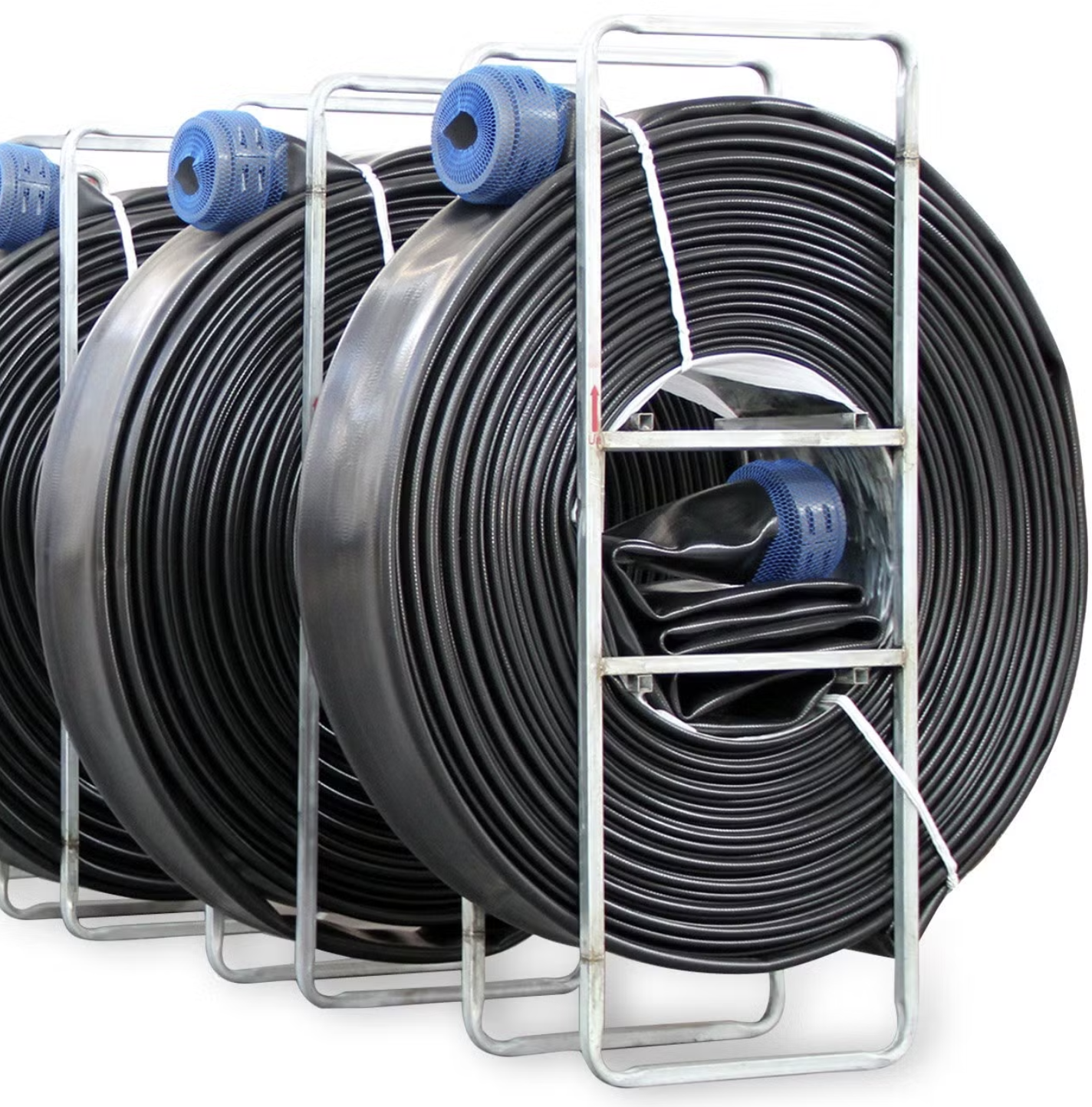
Thermoplastic polyurethane is one of the most durable materials for industrial layflat hoses. Compared with PVC, TPU offers better wear resistance, flexibility, and performance in demanding environments.
Common advantages include:
These properties make TPU an ideal material for heavy-duty water transfer applications.
Manufacturing begins with careful material selection.
The main materials include:
| Material | Purpose |
|---|---|
| Thermoplastic polyurethane | Inner liner and outer cover |
| High-strength polyester yarn | Reinforcement jacket |
| Copper wire (optional) | Static electricity dissipation |
| Color masterbatch | Product identification |
| Additives | Improve UV and weather resistance |
The quality of TPU resin directly affects:
Manufacturers usually dry TPU pellets before processing because excessive moisture can create bubbles or surface defects during extrusion.
The strength of a layflat hose depends heavily on its reinforcement.
High-tenacity polyester yarn is prepared through:
Consistent yarn quality helps the hose maintain stable working pressure throughout its service life.
The polyester yarn is woven into a seamless circular jacket using high-speed circular looms.
During weaving, manufacturers control:
The woven reinforcement determines much of the hose's:
A uniform woven jacket also helps maintain consistent wall thickness after TPU extrusion.
This is one of the most important production stages.
Molten thermoplastic polyurethane is extruded through and around the woven polyester reinforcement under controlled temperature and pressure.
Unlike glued constructions, extrusion-through-weave creates strong mechanical bonding between TPU and the textile reinforcement.
Benefits include:
Proper temperature control also helps produce consistent wall thickness throughout the hose.
After extrusion, the hose passes through a controlled cooling system.
This process stabilizes:
Gradual cooling reduces internal stress and helps the hose maintain stable dimensions.
The hose is then cut according to customer requirements.
Common lengths include:
Manufacturers verify:
Custom lengths are also available for irrigation, mining, and industrial applications.
Product identification is printed directly on the hose surface.
Typical markings include:
Permanent printing makes product identification easier during installation and maintenance.
Every professional manufacturer performs pressure testing before shipment.
Typical tests include:
The hose operates continuously under its specified working pressure without leakage or permanent deformation.
The hose is pressurized until failure to determine its maximum burst pressure.
In many industrial applications, the burst pressure is several times higher than the normal operating pressure, providing an additional safety margin.
Manufacturers confirm that every production batch meets its designed pressure rating.
Testing may include:
Consistent wall thickness is important for maintaining pressure performance and durability.
Manufacturers use precision measuring equipment to verify:
Uniform wall thickness also improves flexibility and reduces uneven wear during use.
Before packaging, every hose undergoes comprehensive quality inspection.
Inspection items typically include:
Only products that pass all inspection standards proceed to shipment.
Several manufacturing factors influence the final pressure capability.
Higher-strength yarn and optimized weaving improve pressure resistance.
A properly designed wall thickness helps the hose withstand higher internal pressure while maintaining flexibility.
Premium thermoplastic polyurethane provides better wear resistance, elasticity, and bonding with the reinforcement.
Stable production parameters help ensure uniform pressure performance throughout the hose.
Routine pressure testing ensures each production batch meets its specified pressure rating.
A TPU layflat hose is used in industries where lightweight construction, high pressure performance, and abrasion resistance are required. Its flexibility also allows for quick deployment and easy transportation in demanding job sites.
Common applications include:
For shale gas extraction, TPU layflat hoses are widely used to transport large volumes of water between storage ponds, pumping stations, and hydraulic fracturing equipment. Their high abrasion resistance, flexibility, and ability to handle demanding working pressure conditions make them well suited for rugged oilfield environments.
When comparing products, consider more than the price.
Look for:
Manufacturers with modern production equipment and strict quality management generally provide more reliable products for long-term use.
A TPU layflat hose is a reinforced flexible hose made with thermoplastic polyurethane and a woven polyester jacket. It combines high strength, abrasion resistance, and flexibility for demanding fluid transfer applications.
Working pressure depends on the hose design, reinforcement structure, wall thickness, material quality, and manufacturing process. Each hose should be tested before shipment to verify its rated operating pressure.
Working pressure is the maximum pressure the hose is designed to handle continuously during normal operation.
Burst pressure is the pressure at which the hose fails during controlled testing. It is significantly higher than the normal operating pressure and is not intended for regular use.
Wall thickness affects pressure resistance, durability, flexibility, and wear life. Consistent wall thickness also helps maintain stable performance throughout the hose.
TPU provides better abrasion resistance, greater flexibility, higher tear strength, and longer service life. It also performs well in cold environments and under repeated bending, making it suitable for many heavy-duty applications.
Manufacturers typically perform dimensional inspection, hydrostatic pressure testing, burst pressure testing, adhesion testing, flexibility evaluation, and appearance inspection before packaging.
The performance of a TPU layflat hose depends on every stage of the manufacturing process. From selecting premium thermoplastic polyurethane and weaving high-strength polyester reinforcement to controlling wall thickness, verifying working pressure, and testing burst pressure, each step contributes to a hose that delivers reliable performance in demanding conditions.
When choosing a supplier, look beyond price. A manufacturer with advanced production equipment, strict quality control, and complete pressure testing is more likely to deliver a heavy-duty, durable flexible hose that performs consistently in real-world applications.
© 2026 Yoonad Hose | Yoonad Group | All right reserved Created by WIGOR