

Selecting the right high pressure layflat hose requires more than checking the hose diameter or maximum pressure number. The correct choice depends on several factors, including working pressure, flow requirements, hose material, abrasion conditions, temperature range, and application environment.
A high pressure layflat hose is widely used in industries that require flexible and efficient fluid transfer, such as:
Among different hose materials, thermoplastic polyurethane (TPU) has become a preferred option for demanding applications because it combines high flexibility, strong mechanical performance, and excellent abrasion resistance.
This guide explains how to select the right high pressure layflat hose based on pressure rating, size, construction, and real-world applications.
A high pressure layflat hose should be selected based on:
| Selection Factor | What to Consider |
|---|---|
| Working Pressure | Normal operating pressure, maximum pump pressure, pressure fluctuations |
| Hose Size | Required flow rate, distance, pump capacity, pressure loss |
| Material | TPU, PVC, rubber, chemical compatibility |
| Reinforcement | Polyester yarn strength and hose construction |
| Abrasion Resistance | Ground conditions, dragging frequency, external wear |
| Application | Mining, fracking, irrigation, emergency water transfer |
For heavy-duty applications, a TPU high pressure layflat hose is often selected because it provides excellent abrasion resistance, flexibility, and long service life.
A high pressure layflat hose is a flexible hose designed to transport large volumes of liquid while remaining easy to store, transport, and deploy.
Unlike rigid pipes, a layflat hose can be rolled into a compact size when not in use. When pressurized, the hose expands into a round shape to allow water or other fluids to flow.
Typical construction includes:
The reinforced structure allows the hose to handle high working pressures while maintaining flexibility.
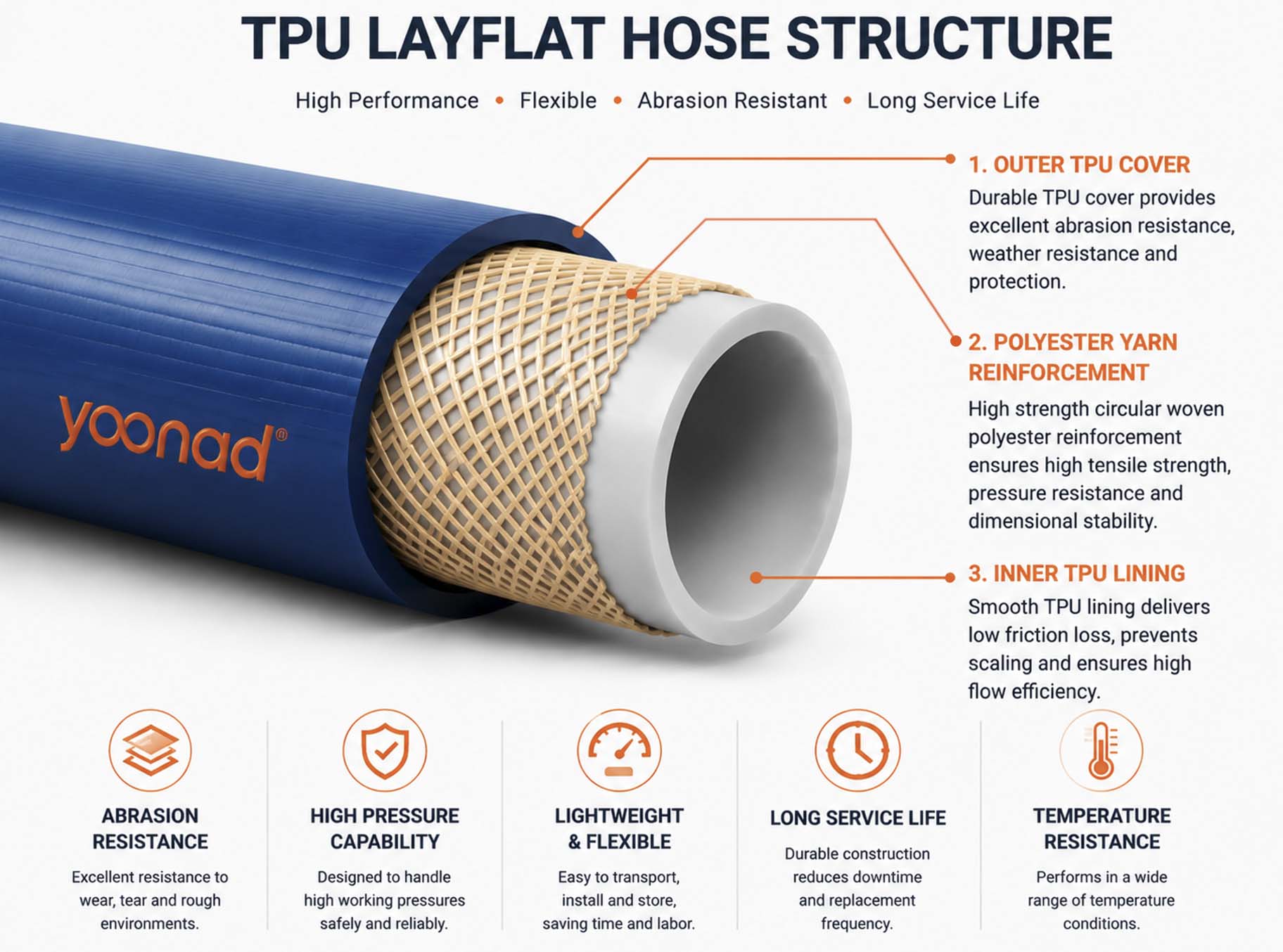
TPU stands for thermoplastic polyurethane, an advanced polymer material known for:
TPU combines some advantages of rubber and engineering plastics. It can withstand repeated bending, dragging, and harsh outdoor environments.
The first step is understanding the pressure requirements of your system.
Important pressure terms include:
The maximum pressure the hose can safely handle during continuous operation.
The pressure level where hose failure may occur.
The difference between working pressure and burst pressure.
A hose should always be selected according to the actual operating pressure, not only the pump's maximum output.
For example:
Hose diameter directly affects:
Common high pressure layflat hose sizes include:
| Hose Diameter | Typical Applications |
|---|---|
| 2"-4" | Agriculture, construction, general water transfer |
| 6"-8" | Mining, industrial pumping, large irrigation |
| 10"-12"+ | High-volume water transfer, mining, fracking |
A larger diameter hose can transport more water with lower friction loss.
However, oversized hoses may increase:
The best size depends on the required flow rate and operating distance.
Abrasion resistance is one of the most important factors in demanding environments.
A hose used on smooth surfaces experiences much less wear than one dragged across:
TPU layflat hoses provide strong abrasion resistance because the TPU outer layer protects the reinforcement structure from mechanical damage.
For applications such as:
a heavy-duty TPU hose can reduce replacement frequency and maintenance costs.
Different materials perform differently under various operating conditions.
Advantages:
Recommended for:
Advantages:
Common uses:
Advantages:
Limitations:
Hydraulic fracturing requires the transportation of large volumes of water at high pressure.
During shale gas extraction, water and other fluids are pumped underground to create fractures in rock formations.
A specialized frac hose must withstand:
Fracking hoses made with TPU provide:
For oil and gas operations, selecting the correct hose pressure rating helps improve operational reliability.
Mining operations often require continuous removal of water from:
Mining environments create challenging hose conditions:
A high pressure TPU layflat hose is suitable for mining dewatering because it provides:
Agricultural irrigation requires efficient water movement across large areas.
Layflat hoses are commonly used for:
Advantages include:
TPU irrigation hoses are especially useful where hoses need frequent movement between fields.
Emergency teams often need equipment that can be transported and deployed quickly.
High pressure layflat hoses are used for:
Their advantages include:
Before purchasing, confirm the following:
✓ What fluid will be transported?
✓ Is the hose used indoors or outdoors?
✓ Will the hose contact abrasive surfaces?
✓ Required working pressure
✓ Maximum pump pressure
✓ Required safety factor
✓ Required flow rate
✓ Hose diameter
✓ Pump distance
✓ Abrasion resistance
✓ Temperature range
✓ Chemical compatibility
✓ Expected service life
✓ Storage conditions
✓ Maintenance frequency
A lower-cost hose may require more frequent replacement.
For industrial operations, total operating cost often depends on:
A hose suitable for agricultural irrigation may not perform well in mining environments.
Applications with frequent dragging require stronger abrasion resistance.
Using a hose below the required pressure level can create safety risks and shorten service life.
Always match the hose pressure rating with the actual working conditions.
TPU is one of the preferred materials for high pressure layflat hoses because thermoplastic polyurethane provides excellent abrasion resistance, flexibility, and mechanical strength.
It is commonly used in mining, hydraulic fracturing, industrial water transfer, and emergency response applications.
Choose the hose size based on:
Larger diameter hoses are usually selected for applications requiring large volumes of water.
A frac hose is used in hydraulic fracturing operations to transport water and fluids during shale gas extraction.
It is designed for high pressure conditions, frequent movement, and abrasive working environments.
Yes. TPU layflat hoses are widely used for mining dewatering because they offer:
Service life depends on:
A properly selected TPU hose can provide a longer service life in demanding applications compared with many standard hose materials.
The pressure rating depends on:
High pressure TPU layflat hoses can be customized for different industrial requirements.
Choosing the right high pressure layflat hose requires careful consideration of pressure rating, hose size, material performance, and application conditions.
For demanding industries such as:
TPU layflat hoses provide a reliable combination of flexibility, durability, and abrasion resistance.
By selecting the correct hose specifications and working with an experienced TPU layflat hose manufacturer, companies can improve operating efficiency, reduce maintenance requirements, and achieve longer service life from their hose systems.
© 2026 Yoonad Hose | Yoonad Group | All right reserved Created by WIGOR