

Compared with rigid irrigation pipe, a layflat hose can be rolled flat when empty. This makes transport, storage, deployment, and collection easier, especially for large farms and temporary irrigation systems.
A TPU layflat hose is a flexible water delivery hose designed to flatten when there is no internal pressure and expand when water flows through it. TPU, or thermoplastic polyurethane, is used for the hose body because it offers good flexibility, wear resistance, and chemical resistance.
For agricultural irrigation, the hose is normally connected to a pump, water source, manifold, sprinkler system, drip irrigation system, or other water distribution equipment. It can be used for both temporary and semi-permanent water transport applications.
The basic structure typically consists of a TPU inner tube, TPU outer layer, and high-tenacity circular-woven polyester reinforcement. The reinforcement helps the hose handle internal water pressure while maintaining flexibility.
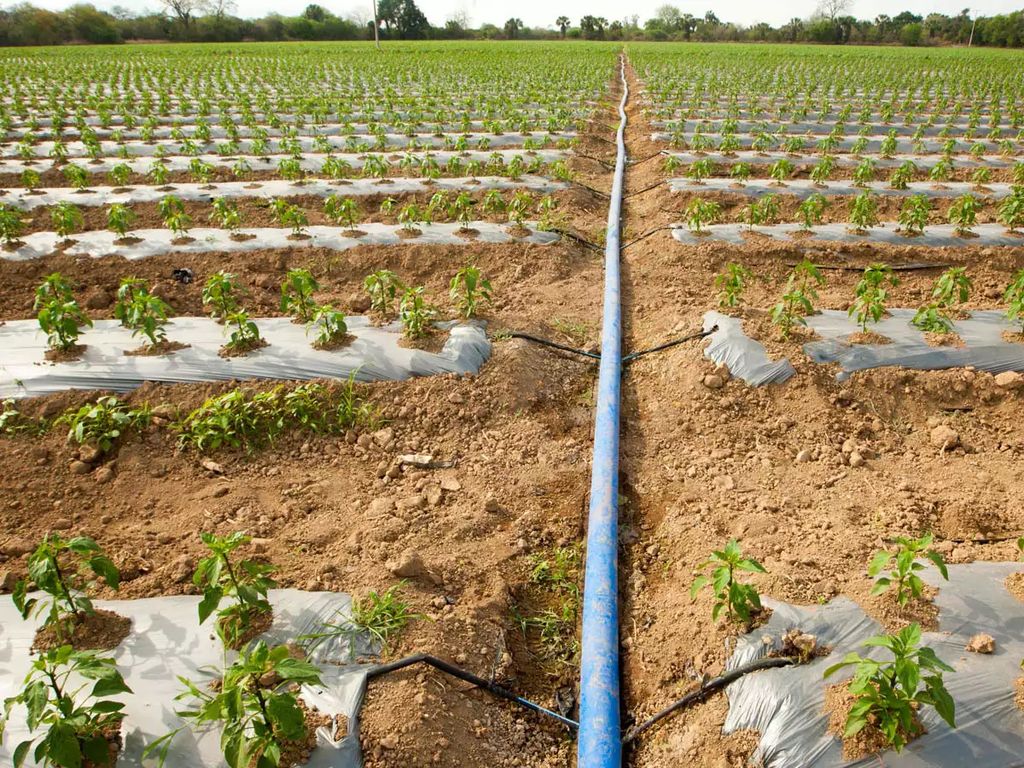
Agricultural water transfer can involve long distances, uneven ground, repeated installation, and frequent movement of irrigation equipment. A hose needs to withstand these conditions while remaining practical to handle.
TPU layflat hose provides several useful characteristics for this type of work.
The hose can be rolled and transported in a compact form when empty. Workers can deploy it across fields, between water sources and irrigation equipment, and along temporary water routes.
After use, the hose can be drained, collected, rolled, and stored.
This is useful when irrigation layouts change during the growing season.
High pressure is often required when water must travel over long distances or supply sprinklers and other irrigation equipment.
A properly selected TPU layflat hose can provide pressure-rated water transport while remaining lighter and easier to handle than many rigid pipe systems.
The actual working pressure should always be selected according to hose size, construction, operating conditions, fittings, and the manufacturer's pressure rating.
Agricultural irrigation water may contain fertilizers, minerals, treatment chemicals, or other substances.
TPU offers good chemical resistance for many water-transfer conditions. However, chemical compatibility depends on the specific chemical, concentration, temperature, exposure time, and TPU formulation.
For systems that use fertilizer injection or chemical treatment, compatibility should be checked before installation.
Agricultural hoses are often pulled across soil, gravel, concrete, and other surfaces. Repeated movement can cause wear.
TPU has strong abrasion resistance compared with many conventional flexible hose materials. A reinforced TPU layflat hose is therefore suitable for applications where the hose may be moved or repositioned regularly.
One advantage of layflat hose is its flat profile when depressurized.
Compared with rigid irrigation pipe, it can take up less space during transportation and storage. Long hose lengths can also reduce the number of connections required along a water route.
This can help simplify field installation.
The best hose depends on the irrigation system, water pressure, installation method, and operating environment.
| Feature | TPU Layflat Hose | Conventional Rigid Pipe | Typical Flexible PVC Hose |
|---|---|---|---|
| Water transport | Excellent | Excellent | Good |
| Flexibility | High | Low | High |
| Layflat design | Yes | No | Some types |
| High-pressure applications | Available | Available | Depends on construction |
| Abrasion resistance | High | High | Moderate to high |
| Chemical resistance | Good, application-dependent | Material-dependent | Material-dependent |
| Storage | Compact when empty | Requires fixed storage space | Relatively compact |
| Field deployment | Fast | Slower | Fast |
| Repeated relocation | Suitable | Less convenient | Suitable |
The comparison should be based on the actual irrigation requirements rather than material name alone. Pressure rating, diameter, length, connection method, temperature, chemical exposure, and ground conditions all affect hose selection.
TPU layflat hose can be used in a range of agricultural water-transfer systems.
The hose can connect a pump to an irrigation header, sprinkler system, storage tank, or field distribution point.
It is useful when the water source and irrigation area are separated by a significant distance.
Sprinkler systems require a reliable water supply at the required pressure.
A pressure-rated TPU layflat hose can transport water from the pump or main water source to sprinkler equipment.
Drip irrigation systems normally use smaller distribution lines, but layflat hose can be used as a main or temporary water supply line between the pump, storage tank, filtration unit, and field distribution system.
Where water needs to be moved from a canal, reservoir, pond, or other source to a field, a layflat hose can provide a flexible connection.
It can also be removed when the irrigation cycle is complete.
Long hose lengths can help reduce the number of intermediate connections in large agricultural fields.
For large farms, hose diameter and pressure loss should be calculated according to required flow rate and transport distance.
For seasonal crops, rented farmland, field rotation, or changing irrigation layouts, flexible hose can be easier to relocate than permanent pipe.
Choosing the correct hose starts with the operating conditions.
Flow rate is one of the first specifications to establish.
A larger hose diameter can generally carry a higher water flow with lower velocity and lower friction loss, but the correct size depends on the pump and irrigation system.
Do not select a hose based only on maximum pump pressure.
Consider normal operating pressure, pump start-up pressure, pressure fluctuations, elevation changes, and possible water hammer.
The hose working pressure should provide an appropriate margin for the actual system.
Common irrigation hose sizes vary by application.
Smaller diameters may be suitable for localized irrigation systems, while larger diameters are more suitable for high-flow water transport.
The correct diameter should be calculated from flow rate, distance, pressure requirements, and pump performance.
If irrigation water contains fertilizers, disinfectants, cleaning agents, or other chemicals, verify the hose material's chemical compatibility.
Chemical resistance is not universal. A hose suitable for clean water may have different compatibility when additives are introduced.
If the hose will be dragged across rough soil, gravel, concrete, or other abrasive surfaces, abrasion resistance should receive greater attention.
A reinforced TPU layflat hose can be a suitable choice for repeated field movement, but installation should still avoid unnecessary dragging over sharp objects.
Longer hose sections can reduce the number of joints and connection points.
However, longer sections can also be heavier when filled with water. The installation team should consider handling requirements, pump capacity, pressure loss, and field layout.
A hose is only as reliable as its connection system.
Select compatible couplings, clamps, valves, reducers, and manifolds. Connection size and pressure rating should match the hose and the rest of the irrigation system.
A typical TPU irrigation layflat hose uses several layers that work together.
The inner TPU layer provides the water-contact surface.
It is designed to carry irrigation water while providing flexibility and resistance to wear.
The reinforcement layer provides mechanical strength and helps the hose withstand internal pressure.
High-tenacity polyester yarn is commonly used for this purpose.
The outer TPU layer protects the reinforcement from the surrounding environment and contributes to the hose's abrasion resistance and flexibility.
This construction allows the hose to remain flexible while supporting pressure-rated water transport.
Proper handling can extend hose service life.
Before installation, inspect the hose for cuts, punctures, damaged fittings, or other visible defects.
Prepare the water route where possible. Remove sharp stones, metal edges, and other objects that may damage the hose.
Avoid pulling a pressurized hose across abrasive surfaces.
When connecting the hose, make sure fittings are properly seated and secured.
Open valves gradually where possible. Sudden pressure changes can create unnecessary stress on the hose and connections.
After use, drain the hose before rolling it for storage.
Store the hose away from prolonged direct sunlight, excessive heat, sharp objects, and chemicals that are not compatible with TPU.
Long-distance water transport is a common requirement in agricultural irrigation.
A hose may need to move water from a deep well, reservoir, pond, canal, or storage tank to a remote field.
In these systems, pressure loss becomes increasingly important as the distance increases.
A practical system design should consider:
A larger-diameter hose may reduce friction loss, but it can also increase material cost and handling weight. The final selection should balance hydraulic performance with field handling requirements.
Thermoplastic polyurethane combines properties that are useful for mobile irrigation systems.
It can provide flexibility for field deployment while offering good resistance to abrasion and many common environmental conditions.
Its layflat construction also makes the hose easier to roll and store when the irrigation system is not operating.
For agricultural users who move irrigation equipment between fields, these characteristics can make TPU layflat hose a practical alternative to rigid water-transfer pipe.
Typical specifications for an agricultural TPU layflat hose may include:
| Specification | Typical Range / Option |
|---|---|
| Material | Thermoplastic polyurethane (TPU) |
| Reinforcement | Circular-woven polyester |
| Application | Agricultural irrigation and water transport |
| Hose type | Layflat hose |
| Size | 2"–8" |
| Length | Up to 400 m |
| Operating temperature | Depending on hose construction and grade |
| Pressure rating | Application-specific |
| Water transfer | Suitable for pressure-rated systems |
| Chemical resistance | Good, depending on chemical and concentration |
| Abrasion resistance | High |
Actual specifications should be confirmed for the selected hose model and operating conditions.
A TPU layflat hose is used to transport water between pumps, reservoirs, canals, tanks, irrigation headers, sprinklers, and agricultural fields. Its flexible construction makes it suitable for temporary and mobile irrigation systems.
Yes, pressure-rated TPU layflat hose can be used for high-pressure irrigation and water transport. The correct model must be selected according to the required working pressure, hose diameter, pump conditions, and system design.
Thermoplastic polyurethane offers flexibility, abrasion resistance, and good chemical resistance for many water-transfer conditions. These properties make TPU useful for irrigation systems where hoses are frequently moved or exposed to demanding field conditions.
It can be suitable for some fertilizer-treated water applications, but chemical compatibility should be checked first. The type and concentration of fertilizer, water temperature, exposure time, and TPU formulation can affect compatibility.
TPU layflat hose can be manufactured in long sections. Some configurations can reach lengths of up to 400 m. The practical length depends on hose diameter, transportation, installation, pressure loss, and handling requirements.
Agricultural TPU layflat hose can be supplied in different diameters. Typical sizes may range from 2 inches to 8 inches, depending on the product series and application.
Neither material is automatically better for every irrigation system. TPU is often preferred when flexibility, abrasion resistance, and pressure-rated water transport are important. PVC may be suitable for applications with different cost or operating requirements.
Yes. A TPU layflat hose can be reused when it is correctly selected, installed, inspected, and stored. Regular inspection helps identify damage before the hose is returned to service.
Drain the hose completely, clean it when necessary, and roll it without sharp folds. Store it in a dry area away from excessive heat, prolonged direct sunlight, sharp objects, and incompatible chemicals.
Start with the required flow rate, working pressure, hose diameter, transport distance, temperature, chemical exposure, ground conditions, and connection type. These factors determine the appropriate hose construction and specification.
For agricultural irrigation, the right hose should match the water flow, pressure, distance, field conditions, and handling method.
TPU layflat hose offers a practical combination of flexible water transport, pressure-rated performance, abrasion resistance, and chemical resistance. Its ability to flatten when empty also makes transportation and storage easier.
For farms that need to move water between different locations, a properly specified TPU layflat hose can provide a flexible solution for seasonal, temporary, and mobile irrigation systems.
Looking for a TPU layflat hose for agricultural irrigation? Contact Yoonad Hose with your required hose diameter, length, flow rate, working pressure, and application conditions. Our team can help match the hose construction to your irrigation system.
© 2026 Yoonad Hose | Yoonad Group | All right reserved Created by WIGOR