

Choosing the right layflat hose material affects service life, maintenance cost, and overall system performance. TPU, NBR, and PVC layflat hoses are widely used for water transfer, agriculture irrigation, mining, construction, oilfield, and industrial applications.
Although they look similar, these materials have significant differences in abrasion resistance, pressure capability, temperature range, chemical resistance, and durability.
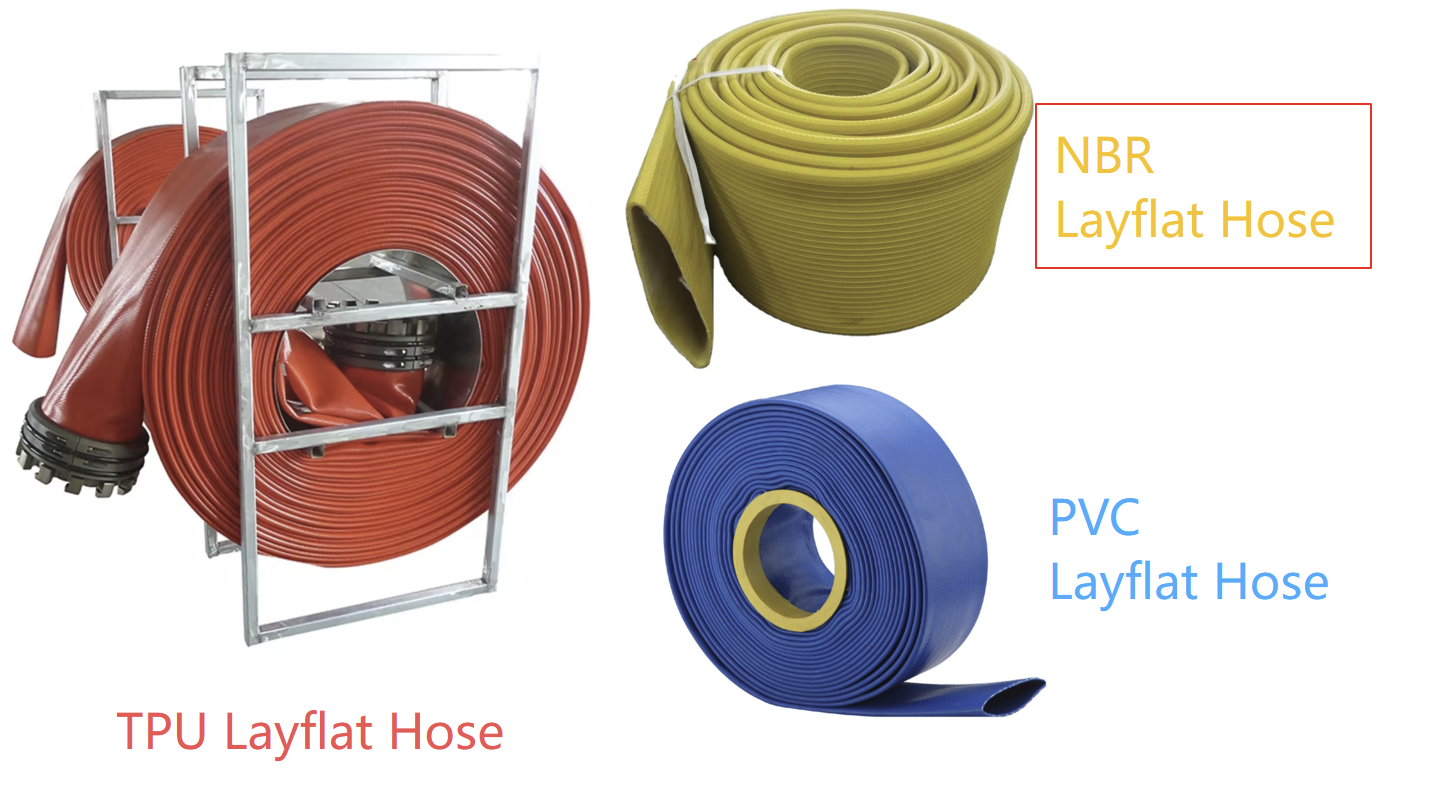
| Performance Factor | TPU Layflat Hose | NBR Layflat Hose | PVC Layflat Hose |
|---|---|---|---|
| Tensile Strength | High (typically 3,000+ PSI depending on structure) | High | Medium |
| Abrasion Resistance | Excellent, suitable for heavy-duty applications | Very Good, especially against oil | Moderate |
| Temperature Range | Approximately -50°C to 80°C (-58°F to 176°F) | Approximately -30°C to 100°C (-22°F to 212°F) | Approximately -10°C to 60°C (14°F to 140°F) |
| Chemical/Oil Resistance | Good chemical resistance, excellent against many industrial fluids | Excellent oil and fuel resistance | Limited resistance to oils and aggressive chemicals |
| Lifespan | Long service life under harsh working conditions | Long service life in oil-related environments | Shorter lifespan under abrasion and outdoor exposure |
Actual performance depends on hose design, wall thickness, reinforcement structure, operating pressure, and working environment.
A layflat hose is a flexible discharge hose designed to transport liquids while remaining flat when empty. Unlike traditional rigid pipes, layflat hoses are lightweight, easy to store, and simple to deploy.
A typical layflat hose consists of:
The reinforcement structure provides pressure strength, while the material determines flexibility, durability, and resistance to environmental conditions.
TPU layflat hose is made from thermoplastic polyurethane (TPU), a material known for high mechanical strength, flexibility, and excellent abrasion resistance.
TPU hoses are widely used in:
Abrasion resistance is one of the biggest advantages of TPU hose.
During operation, layflat hoses often experience:
Compared with PVC hoses, TPU provides much higher resistance against surface wear.
In laboratory abrasion evaluations such as ASTM D4060-based testing methods, TPU materials generally show significantly lower material loss compared with conventional PVC materials.
This means TPU hoses can maintain their mechanical properties for a longer period in demanding environments.
A high pressure layflat hose requires a strong reinforcement structure and durable hose material.
The pressure rating of a TPU hose depends on:
Typical industrial TPU layflat hoses can be designed for:
Always select a hose based on the actual working pressure and required safety margin.
A wider temperature range allows TPU hoses to work in different environments.
Typical TPU layflat hose temperature range:
-50°C to 80°C (-58°F to 176°F)
This makes TPU suitable for:
NBR (Nitrile Butadiene Rubber) is widely used where oil resistance is required.
NBR layflat hoses are commonly selected for:
NBR performs better than TPU and PVC when exposed to many petroleum-based fluids.
NBR provides:
Compared with TPU:
For applications where hoses are frequently dragged over rough surfaces, TPU may provide a longer service life.
PVC layflat hose is widely used because of its:
Common applications include:
PVC hoses usually have lower resistance against:
Under harsh working conditions, frequent replacement may increase total operating costs.
Many buyers compare hoses only by purchase price. However, industrial hose selection should consider the total cost during operation.
The Total Cost of Ownership includes:
A TPU hose may have a higher initial price than PVC, but its longer service life can reduce replacement costs.
A PVC hose may require replacement several times during the service life of a properly selected TPU hose in highly abrasive applications.
Industry experience shows that TPU hoses can often achieve:
Actual lifespan depends on:
Before purchasing a layflat hose, consider the following factors.
Check:
A hose with an unsuitable pressure rating may fail prematurely.
Choose TPU when the hose will face:
Choose NBR when oil resistance is the main requirement.
Choose TPU for applications requiring:
Always match hose material with the working temperature.
Extreme temperatures can affect:
Wall thickness affects:
Heavy-duty applications normally require optimized wall thickness combined with high-strength reinforcement.
TPU irrigation hoses provide:
Mining operations require:
TPU layflat hoses are commonly used for:
High-pressure TPU hoses are suitable for:
Applications include:
For industrial users, the best hose is not always the cheapest option.
A heavy-duty TPU hose provides a balance of:
When operating conditions are demanding, TPU often provides better long-term value compared with standard PVC solutions.
TPU layflat hose offers higher abrasion resistance, better mechanical strength, and longer service life compared with PVC hose. PVC hose is usually selected for lower-cost general water transfer applications.
TPU and NBR serve different applications. TPU is often preferred for abrasion resistance and flexible industrial use, while NBR is commonly selected for oil and fuel resistance.
The service life of a TPU layflat hose depends on operating pressure, environment, fluid type, and maintenance. In harsh abrasion conditions, TPU can provide significantly longer service life than PVC hoses.
Most industrial TPU layflat hoses operate approximately between -50°C and 80°C (-58°F to 176°F), depending on the TPU formulation and hose construction.
The pressure rating depends on diameter, wall thickness, reinforcement design, and manufacturing technology. Industrial TPU hoses can be designed for medium to high-pressure applications.
TPU has a higher material cost, but its superior abrasion resistance, durability, and longer replacement cycle can reduce total operating costs.
For mining applications, TPU layflat hose is often preferred because mining environments require high abrasion resistance, strong pressure performance, and reliable long-term operation.
Choosing between TPU, NBR, and PVC layflat hoses depends on the working environment, pressure requirements, chemical exposure, and expected service life.
PVC is suitable for economical general applications.
NBR is ideal for oil and fuel-related environments.
TPU layflat hose is the preferred solution for heavy-duty industrial applications requiring excellent abrasion resistance, high pressure capability, and long service life.
For demanding water transfer, mining, oilfield, and industrial applications, selecting the right TPU hose design can reduce downtime and improve overall system efficiency.
© 2026 Yoonad Hose | Yoonad Group | All right reserved Created by WIGOR