

When selecting a TPU hose for frac water transfer, consider flow rate, hose diameter, operating pressure, pressure drop, transfer distance, fluid type, temperature, and abrasion conditions. A larger diameter can reduce pressure loss and help maintain the required flow rate over long transfer distances.
For applications such as shale gas extraction, fracturing treatment, and well stimulation, hose selection should be based on the actual flow and pressure requirements rather than hose diameter alone.
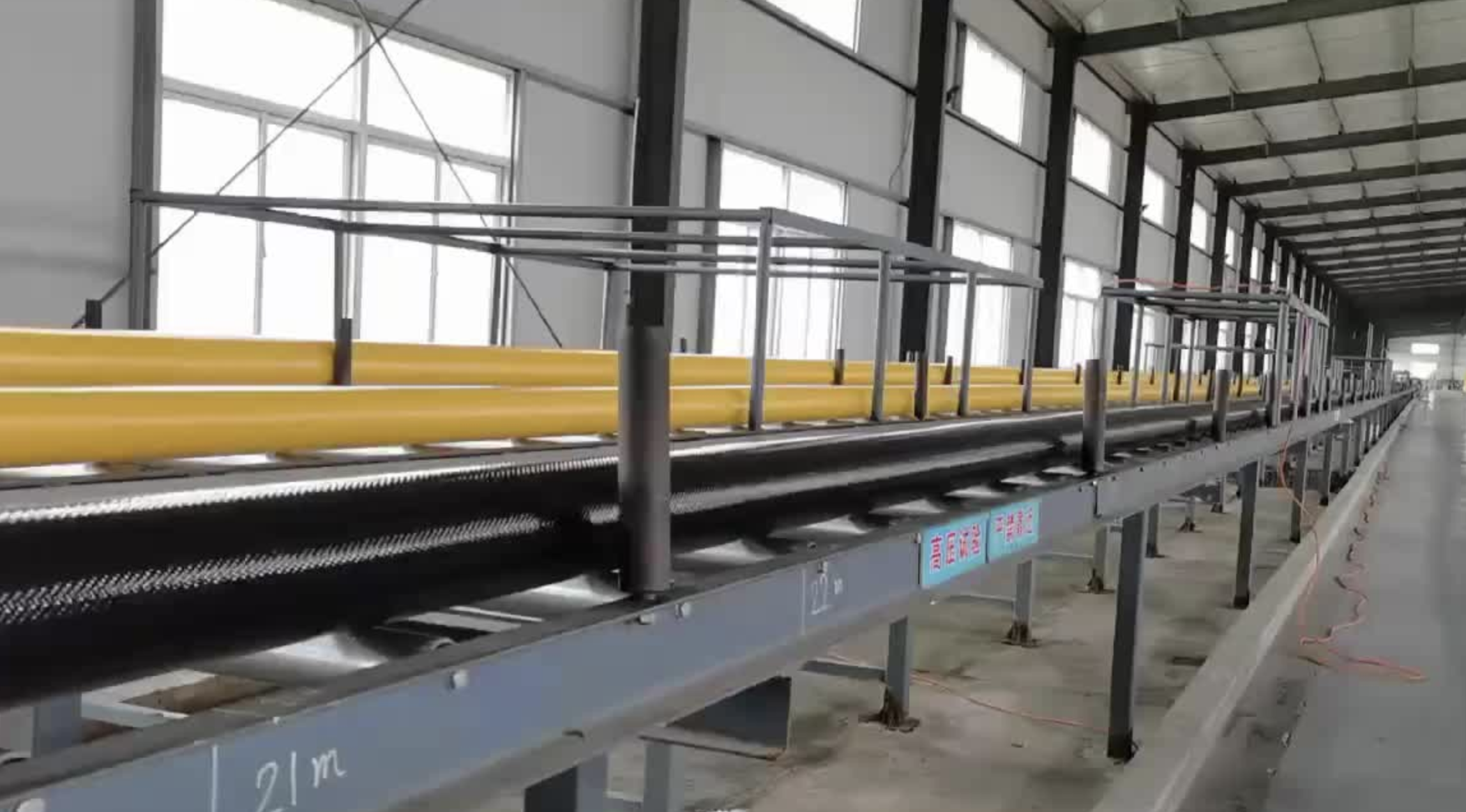
A TPU layflat hose for frac water transfer is a flexible, pressure-rated hose designed to move large volumes of water used in hydraulic fracturing operations.
TPU stands for thermoplastic polyurethane. The hose typically consists of a TPU inner tube, a woven polyester reinforcement layer, and a TPU outer cover.
Unlike rigid pipe, a layflat hose can be rolled flat when empty. This makes it easier to transport, deploy, collect, and store at temporary oilfield water transfer sites.
In frac water applications, the hose may be used to transfer water between storage ponds, tanks, pumps, manifolds, and well sites.
Frac water transfer is the movement of large volumes of water required for hydraulic fracturing operations.
During shale gas extraction, water is commonly transported to the well site and then supplied to equipment used for the fracturing treatment.
A typical water transfer system may include:
The hose is used mainly on the water transfer side of the system. It is not the same as the high-pressure iron pipe or specialized equipment used to inject fracturing fluid directly into a well.
A TPU layflat hose can be used in several parts of a frac water transfer system.
Water can be transferred from a local water source to temporary storage tanks or ponds.
The hose can move water from storage areas to the well pad or frac operation.
Large-diameter layflat hose can be used where water must travel over relatively long distances.
Layflat hose is useful when the water transfer system needs to be installed, moved, or removed quickly.
The hose can also be used for high-volume water discharge from pumps or storage systems.
TPU layflat hose offers several characteristics that can be useful in oilfield water transfer.
Thermoplastic polyurethane provides a combination of flexibility, abrasion resistance, and mechanical strength.
This makes TPU suitable for demanding water transfer environments where the hose may contact gravel, soil, equipment, or other rough surfaces.
A flexible hose system can be easier to transport and deploy than a comparable rigid pipeline.
This lightweight design can reduce handling requirements during temporary water transfer projects.
The actual weight advantage depends on hose diameter, wall construction, reinforcement, and pressure rating.
TPU layflat hose can be rolled and transported in compact form when not in use.
After deployment, the hose expands as water flows through it.
This flexible design can simplify temporary water transfer layouts around a well site.
The hose can use high-tenacity woven polyester as its reinforcement.
The reinforcement helps the hose withstand internal pressure while maintaining flexibility.
The final pressure rating depends on the hose structure, diameter, reinforcement, manufacturing process, and testing.
Frac water transfer sites can contain rocks, gravel, sand, mud, and other abrasive surfaces.
TPU has good abrasion resistance, which can help extend hose service life when the hose is properly selected and handled.
A large-diameter hose can move a high volume of water while keeping flow velocity within a suitable range.
For this reason, TPU layflat hose can be considered for high-flow and large-volume water transfer systems.
Hose sizing starts with the required flow rate.
The basic relationship between flow rate, hose diameter, and flow velocity is:
Q = A × v
Where:
For a circular hose:
A = πD² / 4
This means that hose diameter has a large effect on flow capacity.
For example, increasing hose diameter can allow a large amount of water to pass through the hose at a lower flow velocity.
This is one reason large diameter layflat hoses are commonly considered for high-volume frac water transfer.
A simplified comparison helps show why diameter matters.
| Hose ID | Relative Flow Area |
|---|---|
| 2 in | 1× |
| 3 in | 2.25× |
| 4 in | 4× |
| 6 in | 9× |
| 8 in | 16× |
The flow area increases with the square of the diameter.
Therefore, doubling the internal diameter gives approximately four times the flow area, assuming the same flow velocity.
Actual flow capacity also depends on pressure, hose construction, fluid properties, fittings, pump performance, and system layout.
Flow rate is normally one of the first parameters to establish.
Common units include:
The required flow rate depends on the frac operation and the capacity of the connected equipment.
A hose should not be selected based only on the maximum possible flow rate.
The complete system should be considered, including:
Pressure drop is the loss of pressure as fluid moves through the hose.
For a long water transfer line, pressure drop can become a major factor in pump selection and system performance.
Pressure loss is affected by:
A smaller hose operating at a high flow rate will generally create more friction loss than a larger hose carrying the same volume of water.
Therefore, using a larger hose can sometimes reduce pressure loss and reduce the pump pressure required to achieve the target flow.
Pressure loss increases as the transfer distance increases.
A short hose and a 1,000-meter transfer line cannot be evaluated in the same way.
For long-distance frac water transfer, calculate the total pressure loss across the complete system rather than looking at the hose alone.
The calculation should include:
This gives a more realistic estimate of the pressure available at the discharge point.
A practical selection process can follow these steps.
Start with the required water volume per minute or hour.
Choose a diameter that can provide the required flow without creating excessive pressure loss.
Make sure the hose operating pressure is suitable for the actual pump and system pressure.
A high pressure hose should be selected based on its rated operating pressure, not only its burst pressure.
Longer hose runs can increase pressure loss.
Consider:
The reinforcement should match the required pressure and mechanical load.
A hose system is only as practical as its connections.
The hose, coupling, gasket, valve, and manifold should be compatible with the intended water transfer service.
TPU is not the only material used for water transfer.
Different applications may use rubber hose, PVC hose, HDPE pipe, steel pipe, or other flexible hose designs.
| Factor | TPU Layflat Hose | Rigid Pipe |
|---|---|---|
| Flexibility | High | Low |
| Transport | Easy to roll | More difficult |
| Temporary installation | Suitable | Less convenient |
| Storage | Compact when empty | Requires more space |
| Deployment | Fast | More labor-intensive |
| Abrasion resistance | High with suitable TPU construction | Depends on material |
| Large-volume transfer | Suitable with correct diameter | Suitable |
| Long-distance transfer | Suitable | Suitable |
The best option depends on pressure, flow rate, distance, site conditions, installation time, and project requirements.
Water management is an important part of shale gas extraction.
Water may need to be transported from a source to storage areas and then from storage to the well pad.
Because shale gas projects can involve temporary and changing site layouts, flexible water transfer systems can provide practical installation advantages.
A TPU layflat hose can be used as part of this water transfer network when its pressure rating, diameter, temperature range, and chemical compatibility meet the application requirements.
Well stimulation includes methods used to improve the flow of oil or gas from a well.
Hydraulic fracturing is one form of well stimulation.
In a frac water transfer system, the hose generally handles water movement before the fluid reaches the specialized injection equipment.
This distinction is important.
A frac water transfer hose should not automatically be described as a hose for direct high-pressure fracturing injection into the well.
The required pressure rating and hose construction can be very different.
When comparing TPU hoses for a frac application, consider the following specifications:
| Specification | What to Check |
|---|---|
| Material | Thermoplastic polyurethane |
| Diameter | Match required flow rate |
| Length | Match transfer distance |
| Operating pressure | Match system pressure |
| Reinforcement | Woven polyester or other suitable structure |
| Temperature | Match actual fluid and ambient temperature |
| Fluid | Water or specified transfer fluid |
| Abrasion resistance | Match ground and handling conditions |
| Flexibility | Consider deployment requirements |
| Couplings | Match hose and system connections |
A good Fracking Hose should be selected for the actual service conditions rather than by the word "fracking" alone.
For water transfer applications, important factors include:
For a TPU hose, the material and reinforcement structure should also be reviewed.
A hose intended for frac water transfer should have a clearly defined operating pressure and application range.
Consider a frac water transfer system that requires a high flow rate over a long distance.
A small-diameter hose may appear attractive because it is easier to handle and may have a lower purchase price.
However, the smaller internal diameter can increase flow velocity and pressure loss.
A larger-diameter hose may require more handling equipment, but it can reduce flow velocity and friction loss.
Therefore, the correct selection should consider total system cost, not only hose purchase price.
This includes:
The pump connection does not automatically determine the ideal hose diameter.
The required flow rate and total pressure loss should also be considered.
Burst pressure is not the same as recommended operating pressure.
Always check the manufacturer's rated working pressure and safety requirements.
A hose may have enough pressure capacity but still create excessive friction loss at the required flow rate.
A hose used across rough ground may experience more wear than a hose installed on a clean surface.
Abrasion resistance should therefore be considered when selecting the hose construction.
Frac sites can involve high flow, long distances, heavy equipment, and demanding ground conditions.
A standard low-pressure water hose may not be suitable.
Before ordering a hose, confirm:
This information allows the hose supplier to recommend a more suitable specification.
Yes, TPU layflat hose can be used for frac water transfer when its pressure rating, diameter, temperature range, material compatibility, and construction are suitable for the application.
It is particularly useful for flexible, high-flow water transfer and temporary water distribution systems.
A frac water transfer hose is a hose used to move water for hydraulic fracturing operations. It can connect water sources, storage tanks, pumps, manifolds, and well-site systems.
The term does not refer to one specific hose material.
In many water transfer applications, the terms are used to describe hoses associated with hydraulic fracturing operations.
However, the actual hose design can vary significantly depending on whether it is used for water transfer, fluid transfer, or another part of the frac system.
There is no single best size.
The correct diameter depends on the required flow rate, hose length, pressure loss, pump capacity, elevation, and system layout.
Large-diameter hose is often considered for high-flow and long-distance water transfer.
For the same flow rate, a larger internal diameter generally reduces fluid velocity and friction loss.
This can reduce pressure drop and help maintain the required flow over a long transfer distance.
Yes. TPU layflat hose can be used for water transfer systems associated with shale gas extraction, including the movement of water to storage areas and well sites.
The hose must be selected according to the actual operating conditions.
Neither material is automatically better for every application.
TPU can offer a useful combination of flexibility, lightweight construction, and abrasion resistance. Rubber hoses may be preferred for some pressure, temperature, or fluid conditions.
The correct choice depends on the system requirements.
Frac water refers mainly to water used in hydraulic fracturing operations.
Frac fluid is a broader term for the fluid used during fracturing and may contain water or another base fluid together with additives and other components.
Some TPU layflat hoses are designed for high pressure water transfer.
The actual pressure capability depends on the hose diameter, TPU structure, reinforcement, manufacturing process, and tested pressure rating.
Always select the hose according to its published working pressure.
Pressure drop depends on hose diameter, length, flow rate, fluid properties, internal surface characteristics, and fittings.
For an accurate system calculation, the complete transfer line should be evaluated rather than the hose alone.
TPU layflat hose can provide a flexible solution for frac water transfer where large water volumes need to be moved between sources, storage areas, pumps, and well sites.
The right hose should be selected based on flow rate, diameter, pressure, distance, fluid, temperature, abrasion conditions, and connection requirements.
For shale gas extraction, fracturing treatment, and well stimulation projects, correct hose sizing can help reduce unnecessary pressure loss and support efficient water transfer.
Yoonad Hose develops TPU layflat hose solutions for demanding industrial water and fluid transfer applications, including oilfield water transfer, mining, and hydraulic fracturing-related water transfer systems.
For project-specific selection, provide the required flow rate, hose length, operating pressure, fluid temperature, transfer distance, and connection size so the appropriate hose specification can be evaluated.
© 2026 Yoonad Hose | Yoonad Group | All right reserved Created by WIGOR