

A reliable TPU layflat hose supplier should be able to provide:
| Selection Factor | What Buyers Should Check |
|---|---|
| TPU Material | High-quality thermoplastic polyurethane with strong wear resistance and flexibility |
| Manufacturing Process | Advanced extrusion technology and consistent production control |
| Reinforcement | High-tenacity woven polyester reinforcement for pressure performance |
| Application Experience | Experience in industrial, agricultural, mining, oilfield, and emergency applications |
| Pressure Rating | Suitable working pressure and burst pressure for the application |
| Production Capacity | Stable supply capability for large projects |
| Quality Testing | Hydrostatic pressure, abrasion, tensile strength, and aging tests |
| Customization | Available sizes, lengths, colors, fittings, and specifications |
For demanding applications such as hydraulic fracturing, shale gas extraction, mining dewatering, and long-distance water transfer, choosing an experienced TPU layflat hose manufacturer can improve system reliability and reduce maintenance costs.
A TPU layflat hose is a flexible industrial hose made from thermoplastic polyurethane (TPU) with a reinforced woven polyester structure. It is designed for high-pressure water transfer, fluid delivery, and heavy-duty applications where flexibility, lightweight design, and abrasion resistance are required.
Unlike traditional rubber or PVC layflat hoses, TPU layflat hoses combine high strength, excellent wear resistance, and long service life. They are widely used in agricultural irrigation, mining dewatering, construction, emergency drainage, oilfield water transfer, hydraulic systems, and shale gas extraction projects.
A typical TPU layflat hose structure includes:
Because of its lightweight construction and high pressure capability, TPU layflat hose is often selected for large diameter water transfer systems and long-distance fluid transportation.
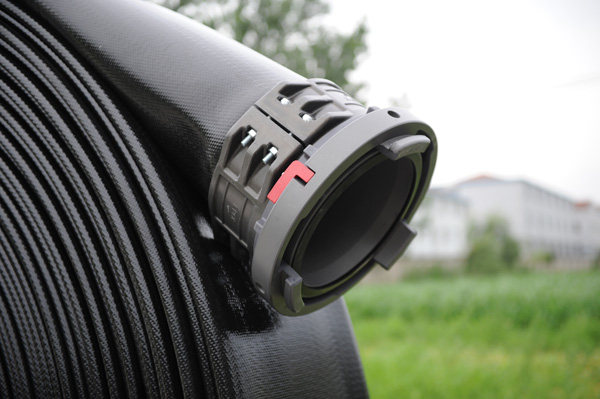
The quality difference between TPU layflat hose manufacturers can directly affect hose performance, operating safety, and total project cost.
A low-quality hose may experience:
For applications such as frac water transfer, hydraulic fracturing, or mining dewatering, hose failure can cause equipment downtime and project delays.
An experienced manufacturer understands how TPU materials, reinforcement structures, extrusion processes, and production control affect final hose performance.
The first step in selecting a TPU layflat hose supplier is understanding the raw material.
High-quality TPU provides:
A professional manufacturer should clearly explain:
For heavy-duty industrial applications, ordinary polyurethane materials may not provide enough performance. High-performance TPU is required for environments involving rocks, mud, sand, chemicals, and repeated movement.
TPU layflat hose production requires accurate control of extrusion, reinforcement, bonding, and cooling processes.
A reliable manufacturer should have:
The extrusion process determines:
Poor extrusion control may lead to uneven thickness and weak points.
The reinforcement layer usually uses high-strength woven polyester.
The woven structure provides:
Manufacturers with their own reinforcement and extrusion production lines can usually provide more stable quality control.
Different industries require different hose pressure ratings.
Before selecting a manufacturer, confirm:
High pressure TPU layflat hoses are commonly used for:
For hydraulic fracturing and fracking applications, hoses must handle:
TPU layflat hoses are widely used for frac water transfer because they provide a combination of lightweight handling and high pressure capability.
A good TPU layflat hose manufacturer should understand the environment where the hose will operate.
Agricultural users usually need hoses that are:
TPU irrigation hoses are suitable for water delivery systems requiring repeated installation and movement.
Mining operations often involve:
Mining dewatering hoses require strong abrasion resistance and heavy-duty construction.
Shale gas extraction projects require reliable fluid transfer systems for:
TPU layflat hoses are used in shale gas and oilfield projects because they are easier to transport and deploy compared with rigid piping systems.
Emergency response teams need hoses that can be:
Lightweight TPU layflat hoses are commonly used for Flood Emergency Drainage and temporary water removal projects.
A professional manufacturer should provide different specifications according to project requirements.
Common TPU layflat hose options include:
Large diameter TPU layflat hoses are often selected for:
A manufacturer with customization capability can provide a better match for specific systems.
A trustworthy TPU layflat hose manufacturer should have strict inspection procedures.
Important tests include:
Checks whether the hose can withstand rated operating pressure.
Measures maximum pressure before failure.
Evaluates hose durability under friction and harsh working conditions.
Measures reinforcement strength.
Checks long-term performance under environmental exposure.
Quality testing records help buyers understand whether the hose meets industrial requirements.
For projects involving drinking water or sensitive applications, certification requirements should be confirmed.
For potable water transfer applications, buyers should check:
A manufacturer experienced in potable water applications should be able to provide supporting documents.
For large industrial projects, supply stability is as important as product quality.
A capable TPU layflat hose manufacturer should have:
This is especially important for:
A stable supplier helps reduce project delays caused by production shortages.
A professional supplier should provide support before and after purchase.
Good technical support includes:
The best manufacturer is not only a hose producer but also a technical partner who understands fluid transfer requirements.
Before placing an order, buyers can use this checklist:
| Question | Why It Matters |
|---|---|
| Does the manufacturer produce TPU hoses directly? | Ensures production control |
| What TPU material is used? | Determines durability |
| Does the hose use woven polyester reinforcement? | Affects pressure strength |
| What pressure ratings are available? | Ensures application compatibility |
| Can they supply large diameter hoses? | Supports high-flow systems |
| Do they perform quality testing? | Confirms reliability |
| Do they have industry experience? | Reduces selection risks |
| Can they provide customization? | Matches project requirements |
Yoonad Hose is the industrial hose division of Yoonad Group, specializing in TPU layflat hoses and fluid transfer solutions for global industrial applications.
The company provides TPU hose solutions for:
With advanced manufacturing capabilities, Yoonad Hose focuses on producing lightweight, flexible, high-pressure TPU layflat hoses designed for demanding environments.
Its TPU hose products feature:
Look for TPU material quality, manufacturing experience, extrusion technology, reinforcement structure, pressure ratings, testing standards, and industry experience.
TPU generally provides better abrasion resistance, flexibility, and durability than standard PVC hoses. It is often selected for demanding applications such as mining, industrial water transfer, and hydraulic fracturing.
Yes. High-quality TPU layflat hoses with reinforced woven polyester structures are designed for high pressure water transfer and industrial fluid delivery.
Yes. TPU layflat hoses are used in shale gas extraction projects for frac water transfer and large-volume fluid transportation because they are lightweight, flexible, and easy to deploy.
Common industries include:
Service life depends on operating pressure, fluid type, environment, frequency of use, and maintenance. High-quality TPU hoses typically provide longer service life because of their abrasion resistance and durable reinforcement structure.
Choosing the right TPU layflat hose manufacturer requires careful evaluation of materials, production technology, pressure performance, application experience, and quality control.
For industrial projects involving high pressure water transfer, mining dewatering, hydraulic fracturing, shale gas extraction, agricultural irrigation, or emergency drainage, selecting an experienced TPU hose supplier can improve reliability and reduce long-term operating costs.
A manufacturer with strong engineering knowledge, stable production capability, and proven application experience can provide TPU layflat hose solutions that meet demanding fluid transfer requirements.
© 2026 Yoonad Hose | Yoonad Group | All right reserved Created by WIGOR