

A well-designed layflat hose can offer high flow rates while remaining flexible and easy to transport. For oil and gas operations, key selection factors include pressure rating, chemical resistance, wear resistance, temperature range, diameter, length, coupling design, and expected operating conditions.
For shale gas extraction, TPU layflat hose is often considered where operators need a combination of high pressure performance, resistance to abrasion, flexibility, and a wide temperature range.
A high-pressure layflat hose is a flexible hose designed to carry pressurized fluids while remaining flat when empty. Unlike rigid pipelines, it can be rolled, transported, deployed, drained, and retrieved as project conditions change.
A typical lay flat hose has a flexible inner tube, reinforcement layer, and outer protective surface. The reinforcement gives the hose its pressure capacity. The outer layer protects the hose from mechanical wear and contact with the ground.
For water transfer operations, the hose is commonly connected to pumps, manifolds, tanks, water sources, or temporary pipelines. Its ability to be rolled into compact sections makes it suitable for temporary and semi-permanent water transfer projects.
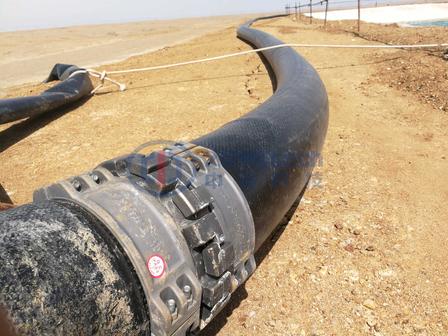
Shale gas extraction can require large amounts of water. Water may need to move from ponds, tanks, water treatment systems, or supply points to drilling and hydraulic fracturing areas.
The distance between these locations can change from one project to another. A fixed pipeline may not always be practical. A layflat hose provides a more flexible option.
Long-distance water transfer is common in oil and gas operations. A hose system can be installed along a planned route and connected in sections.
Depending on the hose diameter, pump capacity, pressure, and system design, operators can achieve the flow rates required for the project.
Layflat hose can be transported in coils or reels. This reduces the space required during transportation.
Workers can deploy the hose along roads, access routes, or designated work areas. After the water transfer project is completed, the hose can be drained, rolled, and moved to another location.
This makes layflat hose useful when water transfer routes change frequently.
Rigid pipe requires more handling equipment and storage space. Layflat hose is generally easier to move and reposition.
For temporary water supply systems, this can simplify installation and removal work.
Pressure is one of the first specifications to check when selecting a water transfer hose.
A high-pressure layflat hose must be matched to the pump pressure and operating conditions. The hose should not be selected only by its nominal working pressure. Operators should also consider pressure surges, temperature, fittings, elevation changes, and the expected operating cycle.
For example, a system may experience pressure changes when pumps start or stop. These changes can affect hose performance even when the normal operating pressure is within the hose rating.
A suitable hose should therefore have a clearly defined working pressure and, where applicable, burst pressure based on recognized test methods.
Water used in shale gas extraction is not always chemically neutral.
Depending on the operation, transferred fluids may contain treatment chemicals, suspended solids, salts, or other substances. The hose material must be compatible with the fluid being transported.
Chemical resistance depends on the hose material and the specific chemical exposure.
TPU is used in many industrial hose applications because certain TPU formulations provide good resistance to oils, abrasion, and a range of industrial fluids. However, chemical compatibility should always be checked against the actual fluid composition and concentration.
For oil and gas industry applications, operators should request chemical compatibility information from the hose manufacturer rather than relying only on the general material name.
Water transfer hoses are often installed on rough surfaces. They may come into contact with gravel, soil, rocks, equipment, and other objects.
This creates mechanical stress during both operation and handling.
A hose with good wear resistance can better tolerate repeated contact with abrasive surfaces. Resistance to abrasion is particularly important when the hose is frequently moved or when the installation route cannot be kept completely free of rough ground.
For shale gas extraction sites, hose construction should therefore be evaluated together with the installation environment.
A stronger outer cover can help protect the reinforcement and inner tube from external damage. However, hose performance also depends on bending radius, pressure, dragging practices, coupling design, and maintenance.
Shale gas extraction can take place in areas with large seasonal temperature changes.
A water transfer hose may be exposed to cold mornings, hot summer surfaces, direct sunlight, and temperature changes during operation.
A hose designed for a wide temperature range can provide more consistent service across different operating conditions.
The actual temperature rating should include both the ambient temperature and the temperature of the transferred fluid. Chemical exposure can also change material behavior at elevated or low temperatures.
The best solution depends on the project.
| Factor | Layflat Hose | Rigid Pipeline |
|---|---|---|
| Deployment | Fast and flexible | More installation work |
| Transportation | Compact when rolled | Requires more space |
| Route changes | Easy to reposition | More difficult |
| Temporary projects | Well suited | Often less flexible |
| Storage | Compact | Requires dedicated space |
| Abrasion exposure | Requires proper hose selection | Depends on pipe and coating |
| Long-term fixed installation | Application dependent | Often suitable |
| Water transfer | Widely used | Widely used |
Layflat hose is particularly attractive where mobility and rapid deployment are important.
Rigid pipelines can be more appropriate for permanent infrastructure or applications where the route will remain unchanged for many years.
Frac water transfer requires reliable movement of water between different parts of an extraction site.
A typical frac water transfer system may include:
The hose must be selected according to the pressure and flow requirements of the complete system.
A larger hose diameter can reduce pressure loss at a given flow rate, but the final selection depends on pump capacity, distance, elevation, fittings, and project requirements.
Hose diameter has a direct effect on the amount of water that can move through a system.
A larger diameter generally allows higher flow rates with lower friction loss at the same flow velocity. However, increasing diameter also affects hose weight, handling, transportation, and cost.
For this reason, operators should calculate the complete hydraulic system rather than choosing the largest available hose.
The calculation should consider:
The final hose size should provide the required water supply without creating unnecessary pressure loss.
The Permian Basin is one example of an oil and gas region where water logistics can be a major part of field operations.
Water may need to be transported across significant distances between supply points, storage facilities, treatment systems, and well sites.
In such environments, a flexible water transfer hose can help operators adjust routes and move equipment as field conditions change.
The exact hose design should be selected for the local ground conditions, pressure requirements, water chemistry, temperature, transfer distance, and expected frequency of reuse.
TPU layflat hose is one option for demanding water transfer applications.
TPU, or thermoplastic polyurethane, can provide a useful combination of flexibility, mechanical strength, and resistance to abrasion. Depending on the formulation and construction, TPU hose can also provide good performance across a wide temperature range.
For oil and gas operations, a TPU hose may be considered when the project requires:
The exact performance depends on the TPU grade, reinforcement construction, wall thickness, hose diameter, operating pressure, and manufacturing process.
Start with the maximum expected operating pressure.
Do not select a hose based only on the normal pump pressure. Include possible pressure surges and other system conditions.
Determine the required water flow before selecting the hose diameter.
A hydraulic calculation can help identify the appropriate diameter and estimate pressure loss.
Identify the actual fluid composition.
Check the hose material against chemicals, additives, salts, hydrocarbons, and other substances that may contact the hose.
Consider the installation surface and handling method.
If the hose will frequently contact rocks or rough ground, resistance to abrasion should be a major part of the selection process.
Check both minimum and maximum temperatures.
The hose should be suitable for the ambient environment and the transferred fluid.
Couplings are part of the complete hose assembly.
The connection should match the required pressure, flow, installation method, and maintenance requirements.
If the hose will be reused, consider how it will be transported, deployed, drained, rolled, and stored.
A hose that is easier to handle can reduce the time required for repeated installation work.
Correct handling can have a major effect on hose life.
Avoid dragging a pressurized hose over sharp objects whenever possible. Keep the hose away from excessive heat, cutting edges, and unnecessary mechanical stress.
Before each deployment, inspect the hose for:
During operation, monitor pressure and look for unusual movement or leakage.
After use, drain the hose where appropriate, clean it according to the fluid being transferred, inspect it, and store it in a suitable location.
A high-performance water transfer hose should balance several requirements rather than focusing on one specification.
High pressure capacity is useful only when the hose also has suitable reinforcement and connections. Chemical resistance matters when the transferred fluid contains aggressive chemicals. Wear resistance matters when the hose is exposed to rough ground.
For projects with continuous operation, the hose should also be selected for its expected duty cycle and handling frequency.
This is why hose selection should be based on the complete operating environment.
A high-pressure layflat hose is a flexible hose designed to transport pressurized fluids while remaining relatively flat when not pressurized. It is commonly used for water transfer, dewatering, irrigation, mining, emergency response, and oil and gas applications.
Yes. Layflat hose can be used for water transfer in shale gas extraction when its pressure rating, flow capacity, material compatibility, temperature range, and mechanical performance match the application.
Frac water transfer is the movement of water required for hydraulic fracturing operations. Water may be transported between supply sources, storage facilities, treatment systems, and well sites.
TPU layflat hose can be suitable for selected oil and gas operations because TPU can offer flexibility, abrasion resistance, and good mechanical performance. The exact hose must be checked for the specific fluid, pressure, temperature, and installation conditions.
Layflat hose can simplify deployment and retrieval, reduce transportation volume, and make it easier to change temporary water transfer routes. These features can be useful for projects that require flexible field logistics.
There is no single operating time that applies to every hose. Continuous operation depends on pressure, temperature, fluid chemistry, flow rate, hose construction, installation conditions, and maintenance. The manufacturer's rated operating conditions should be followed.
Flow rate is affected by hose diameter, pump pressure, transfer distance, elevation, fittings, valves, fluid properties, and system pressure loss. A hydraulic calculation should be used when precise flow performance is required.
Chemical resistance depends on the hose material and construction. Some TPU formulations offer resistance to a range of industrial fluids, but compatibility should be verified against the specific chemicals and concentrations used in the application.
“Layflat hose” describes the flexible, collapsible construction of the hose. “Water transfer hose” describes its application. A layflat hose can therefore be designed and used as a water transfer hose.
Yes, provided the hose is designed for the local operating conditions. Selection should consider pressure, water chemistry, abrasion, temperature, transfer distance, terrain, and deployment frequency.
High-pressure layflat hose provides a flexible solution for water transfer operations in shale gas extraction. Its compact form, flexible installation, and ability to handle high flow rates can make it useful for temporary and semi-permanent water supply systems.
For demanding oil and gas industry applications, hose selection should cover more than pressure rating. Chemical resistance, wear resistance, resistance to abrasion, temperature performance, diameter, couplings, and deployment and retrieval requirements all need to be considered.
For frac water transfer and other oil and gas operations, a properly selected high-performance layflat hose can support efficient water movement while giving field teams greater flexibility than many fixed piping arrangements.
© 2026 Yoonad Hose | Yoonad Group | All right reserved Created by WIGOR